Monday, October 24, 2011

Bellingham Beer Lab

What do beer aficionados do when they have become competent home brewers yet cannot afford to construct their own microbreweries? Illicit and home brewing is popular in North America, but there are few avenues for those who want produce beer on a commercial scale and turn their hobby into a career. My good friend, Josh, is one of five brewers behind the Bellingham Beer Lab, a cooperative brewery that will soon be opening just south of the border. 

At this point in time, Black Star Co-op is the only cooperative brewery in North America. Located in Austin, Black Star is a microbrewery and brewpub that meets operating costs through the sale of memberships. Members  pay a one-time or payment-plan annual fee that entitles them to discounts on beer, voting power for the Board of Directors, free birthday beers, and invitations to exclusive members events. Black Star generates day-to-day funds through their bar, by offering growlers for take-away, distributing kegs to local businesses, and selling merchandise. The Bellingham Beer Lab is using a similar business model to Black Star in that their initial memberships cost $150.00 USD and liquidity is maintained through the brewpub. In short, as a member of the cooperative you are a part owner of the business.

The benefits of this business type extend beyond the creation of local entrepreneurial opportunities and the provision of diverse beverage options. This collective structure promotes development and growth in each brewer, as the co-op is viewed as a transitional enterprise to assist brewers in achieving their goal of opening their own, independent breweries. After one brewer moves out, another moves in. This concept of production is also linked to civic pride and community building. Each brewer within the cooperative will have numerous ties to the neighbourhood and region, and will attract a unique client base. Most cooperative business models, including the BBL, make an effort to incorporate local resources. Some BBL brewers, for example, will make an effort to use Washington State hops and domestic barley. The beer produced by the BBL will, therefore, reflect the people, produce, and pride of Bellingham.

Another great thing about this particular project...it will be located just 45 minutes south of Vancouver. You can become a member, shoot across the border, fill up some growlers, and be back in Vancouver for dinner with your fresh, microbrewed beer. Keep up-to-date with how the business is progressing on Facebook. Just search "Bellingham Beer Lab".

Josh (Right) and the BBL Boys at the 'Best of the Bay' Brew Competition

"Alex Dawkins Vancouver", "Bellingham Beer Lab", "Vancouver Beer"

Tuesday, October 11, 2011

An Australian Cuisine?

No, there isn't really an "Australian cuisine". But if you keep reading, I will tell you about some items and recipes that are uniquely Australian, and appetizing. Having spent the past month down under, I have discovered that Australia is a lot like Canada when it comes to renowned foods and dishes of national pride. That is, both of these countries are so young and such a mishmash of cultures that many popular victuals have appropriated origins. In Canada, Montreal smoked meat can be linked to the Jewish Diaspora from Eastern Europe, and toutins/bannock/beavertails are based on the First Nations' fondness of fried doughs. Australia's widespead consumption of meat pies is directly connected to the country's colonial past, and the popularity of Asian restaurants and supermarkets can be explained by geography, but Aussies have invented some meals and foodstuffs that they can truly call their own:

Lamingtons
Deceptively enjoyable, these coconut coated rectangles of chocolate covered sponge cake can be found in most Australian bakeries. They look fairly bland and one-dimensional but these light and flavourful pastries vary a great deal in terms of texture and composition. Some contain a layer of jam, some have a thick chocolate coating, and sometimes the sponge cake is really dense. I also like lamingtons because they are fairly large and satisfying but are not created with a butter/lard based dough that is the base of so many baked goods.    


Ned Kelly Pies
Due to their colonial origins, Australians love meat pies and sausage rolls, yet they have created several items to call their own. Kangaroo pies are not uncommon, and Ned Kelly Pies can also be found at the better bakeries around the country. Ned Kelly was an outlaw born in 1855, just north of Melbourne, who spent several years in his twenties hiding from the law in the outback. In order to provide extra sustenance for those days in the outback when you are...you know...shooting at coppers and robbing farmers, Ned Kelly Pies are topped with a fried egg and broiled cheese.  We found some acclaimed pies at Beck's Bake House, and I was surprised by how well all of the ingredients melded. I was scared the Ned Kelly would be heavy, like its namesake's infamous iron suit, but it was bold and delectable

BAM: My Sis and Dan

Anzac Biscuits
Associated with the Australian and New Zealand Army Corps (ANZAC), these robust cookies were often sent overseas to the troops of Oceania who were fighting in WWI. Composed of oats, coconut (they love this stuff!), sugar, golden syrup, butter and baking soda, these biscuits did not spoil easily as they travelled thousands of miles to sustain and cheer-up soldiers fighting abroad. They are fairly average when considering ingredients and taste, but they are ubiquitous. Similar to Girl Guide cookies in North America, Anzac biscuits are often sold to support an organization, the Returned and Services League of Australia (RSL). However, they can also be found in most supermarkets and bakeries. 

Pie Floaters
This dish seems as though it should be popular in Eastern Canada or Quebec. It shares traits with Canada's famed poutine and it is ideal for cold weather, rather than the dry heat of South Australia where it originated. This meal looks about as appealing as it sounds. It consists of a meat pie, usually beef, that is served in a bowl of pea soup. To soup-up the unappealing appearance of this hearty delicacy, servers often smother the top of the pie in ketchup. Due to the fact that it is warm most of the time in Australia, and to the fact that the bigger cities here all have great cafes and restaurants, this sloppy mess is usually a favourite of late night carousers.   

"Alex Dawkins", "pie floater"

Saturday, September 10, 2011

October Concert Highlights

Vancouverites are fortunate to have some great gigs coming to town this October; unfortunately, I am in Australia. While I was creating this entry I was perusing the Pollstar website and it really was painful to read about all of the awesome shows that I will be unable to attend. I knew what I was getting myself into when deciding to undertake an eight-month trip though, so I will have to settle for vicarious concert-going experiences, created through Georgia Straight reviews, You Tube clips, and descriptions from friends. Coincidentally, two of the bands that I am (highly) recommending are from Oceania!   

Cut Copy - Vogue - October 7
I am a runner, and a portion of my music harvesting is based around bands that produce complex, 150-bpm music. I am pretty picky when it comes to electronic, up-tempo music though because the repetition and laptop-reliance of most dance music becomes boring after a few minutes. My legs might like run-of-the-mill house music, but my brain needs to be doing something while my body is busy exercising. Bands like Block Party, Daft Punk and Cut Copy use a wide variety of instruments and effects to produce songs that are both stimulating and spirited. Hailing from Melbourne, Cut Copy has been around for more than a decade and are known for creating poppy tracks with clever synth/keyboard effects and smooth vocals. It is rare to find an electronic group that: plays actual instruments, produces great vocals, and walks the line between techno and pop. In Ghost Colours has been on my Shuffle for two years!    

The Naked and Famous - Commodore - October 11
My sister turned me onto this Kiwi group and there are three or four outstanding tracks on their debut album, Young Blood. Their sound is immature right now - some of their songs run out of steam mid-way through and some of the songs end awkwardly - but Alisa Xayalith's dynamic vocals and the band's dense synth-pop compositions are very promising. They are actually in the same category as Cut Copy, but they are not as electronic. This will be a good chance to see some up-and-coming kiwis at Vancouver's best venue.


Friendly Fires - Commodore - October 18
Like Cut Copy's In Ghost Colours, the Friendly Fires debut album from 2008 has been on my running playlist for two years. My favourite song from this debut is 'Jump in the Pool'. Like most of their songs, 'Jump in the Pool' is heavily mixed and super snappy, but all of the digital detailing and  effects cling to a rock nucleus. Unlike The Naked and Famous and Cut Copy, the  Friendly Fires are guitar driven, with synthed percussion often mixed over the band's tracks. The band members met in highschool (in St Albans...where my great grandparents were married!) and originally played dark post-rock. Post-rockers love guitars - especially screwing with them to produce unusual sounds - and this love is evident in the music of the Friendly Fires, despite the glossy production of their past two albums. Ed Macfarlane, the lead singer, started experimenting with keyboards and laptops in university, and then the band as a whole really embraced electronic elements in 2007. The band is currently touring to promote their new album, Pala. 

"A.B.C. Dawkins", "Alex Dawkins", "Vancouver concerts"

Saturday, August 27, 2011

Beyond Pho Bo and Ga

Before I left on my RTW trip in April, everyone told me that food was one of the true highlights when travelling through Vietnam. While I did believe that the food would be great, I was fairly ignorant of Vietnamese cuisine and assumed that the range of dishes would be limited. Before my travels, I had tried pho, salad rolls, spring rolls, brochettes, and canh sour soup. I definitely did not expect the range of regional specialties (from Hoi An's cao lau to Hue's banh khoai), and there are many more snacks/street food options than spring and salad rolls.

I ate pho every two or three days. With its comfort food elements and $1.00 price tag, it is very hard to resist. Most people have heard of pho, but even this ubiquitous noodle soup can vary a great deal when considering spices and ingredients. The good pho shops offer you a bowl containing rice noodles, thin slices of beef (bo) or chicken (ga), chives, Thai basil and a zesty broth...but they also provide you with a side dish containing bean sprouts, kaffir leaves, thin savoury doughnuts, and more basil. You can further customize your soup with the soya, chili sauce, pepper and hoisin sauce on offer. 


I actively sought unfamiliar dishes to avoid getting stuck in a delicious pho rut, and while this did result in the accidental consumption of chien, it also led to some wonderful culinary experiences:


Chao Tom 
I started seeing this dish on menus beginning in Hue. I completed a South-to-North route in Vietnam, and did not see chao tom in restaurants or on streetside barbecues until I reached the country's half-way point. Chao tom consists of a sweet, seasoned shrimp surimi formed around sugarcane spears. The spears are then grilled or barbecued, and often served with a sumptuous selection of accompaniments to be rolled within banh trang (rice paper). These additional ingredients often include julienned carrots, bean sprouts, basil, fried onion, peanuts, and vinegary fish sauce. You remove the shrimp mousse from the sugarcane as you compose your roll and can customize each one.


Hanoi Cha Ca


Cha Ca
This dish originated in Hanoi and was made famous by the Cha Ca La Vong Restaurant. It is so famous in the city that there is even a Cha Ca Street! I went to Cha Ca La Vong but was not impressed by the decor or the staff so opted to dine at the New Day Restaurant on Ma May. This entree is based around grilled pieces of dense, fresh-water catfish (hemibargus) that are served with an aromatic fish broth created using turmeric, saffron, ginger and dill. A plate of ground peanuts, vermicelli noodles, basil, dill and fried onion is usually served with the dish. Like many Vietnamese entrees, cha ca enables the diner to customize their meal. I didn't want my sizzling, spicy fish dish to be transformed into a soup, so I just drizzled some broth over the fish and noodles. The texture of the fish was addictive, and the addition of the peanuts and fried onion created a wonderful contrast with the soft noodles. I'm going to try to make this one at home!     


Cao Lau 
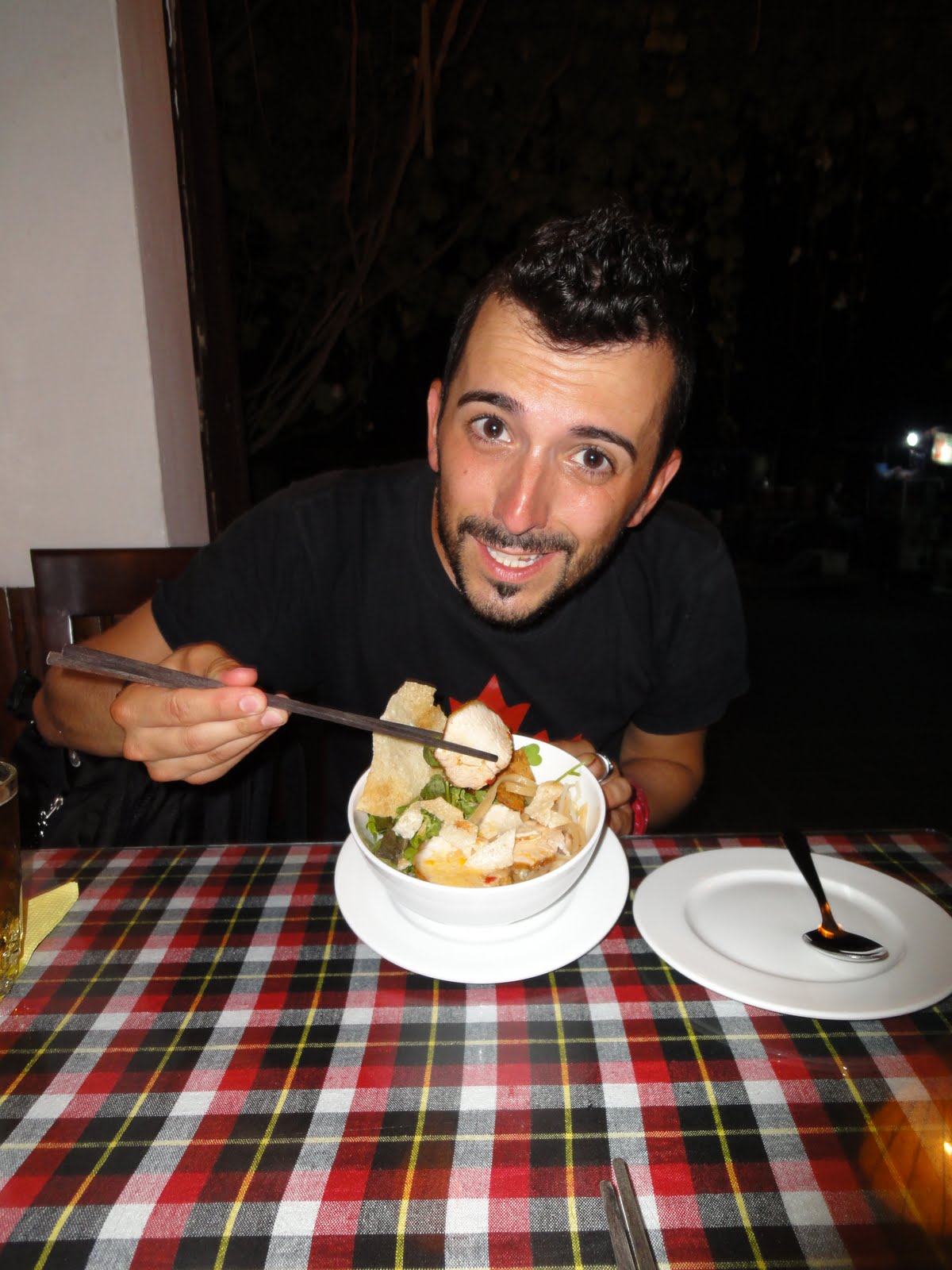
Hoi An prides itself on its colonial connections and its insular ethos. This small, quaint city is a World Heritage Site that is full of tailors, artist workshops, and dainty restaurants. Food is also important to the cultural identity of Hoi An, and there are specific dishes that you will be hard-pressed to find outside of the city. In addition to White Rose Dumplings and Garlic Morning Glory, Cao Lau is a dish that is inextricably connected to Hoi An. Similar to cha ca (above), contrasting textures is key to this noodle dish. It contains broad browned wheat noodles (vermicelli can be used as well), thinly-sliced pork, delicate fried croutons, bean sprouts, mint and cilantro. It is simple but completely satisfying and fun to eat. While the ingredients are pretty much universal, the sauce that coats the noodles can differ a great deal. Some sauces are dark, meaty and salty while other sauces are light, spicy and tangy.


In terms of Vancouver restaurants that offer some unconventional Vietnamese options, My Chau and Green Lemongrass on Kingsway are solid options. While both restaurants promote their pho (yawn), they do offer some tempting alternatives. 

Saturday, July 16, 2011

Arcane Cambodian Cuisine

I can honestly say that I had no idea what Cambodian cuisine consisted of prior to visiting the country this summer. I wasn't particularly surprised by the ingredients used or the dishes favoured by locals, but there were many popular main courses that I had simply never heard of before. While I (usually) believe that it is a cop-out to describe something by simply comparing it to something else, I must say that Cambodian food is like a fusion of Thai flavours and Vietnamese robustness. The chili pepper is not used very much in Cambodian cooking. Heat is often added to a dish through the preparation and use of a paste called kroeung, which is commonly composed of kaffir leaves, pepper, cinnamon, ginger and garlic. This "curry" paste provides many dishes with a dark, murky character that is bold and quickly identifiable. There is also less coconut milk used in Cambodian cuisine, when comparing it to Thai cooking.

While simple noodle and rice dishes are popular throughout Asia, there are certain recipes that are famous in Cambodia. I met-up with a Cambodian friend-of-a-friend while I was in Phnom Penh and she was great in describing these recipes. She also took me to a fancy Khmer restaurant so I could sample some of the dishes. Here is what we tried:

Loc Lac
This is a stir-fried beef dish that is always served with rice. It is easy to recognize because the beef is normally cubed and served on a bed of lettuce. It is a beef party, and few vegetables are invited. The sauce is gravy-like and is composed of garlic, red onion, ginger, tomato,  black pepper and a smidge of ginger. The cubes of beef are traditionally dipped in a paste made from lime juice and black pepper before being eaten or applied to rice. After looking online, I found some reliable sources stating that this dish is Vietnamese in origin, where it is known as Bò lúc lắc or 'Shaking Beef'. However, it is now part of Cambodian culture, and attributing Loc Lac to the country's neighbour probably isn't the best idea when dining in the company of the Khmer. 

Amok
I had this dish twice while I was in Cambodia and really like its simple, fragrant character. Although catfish from Tonle Sap Lake is primarily used in Cambodia, any white fish with a flaky consistency and medium density (such as Tilapia) could be the base for this curry. Similar to Loc Lac, this entree is easy to spot because it is steamed and served in a banana leaf. The fish is mixed with coconut milk, red and green bell peppers, basil leaves and kroeung. It is served with sticky rice.


Samlor Kari
This soup took a little getting used to because it is fairly sour, but the complex flavours and the addition of a neutral meat such as chicken or pork result in a brilliant, stimulating dish. This soup is created from a tamarind base, which provides the tartness, and the broth also contains fish sauce, tomato, garlic, and chilis.

Vancouver has many Thai restaurants, and it even has a good number of Vietnamese/pho restaurants, but options are limited when it comes to Cambodian food. The appropriately-named Phnom Penh Restaurant at 244 East Georgia has received acclaim for its Cambodian-style chicken wings and its Butter Beef dish. While I have heard that prices have increased with its popularity, the Phnom Penh is one of the only places you will be able to sample unique Cambodian flavours outside of...well...Phnom Penh.

Friday, July 1, 2011

Two Drams from the Motherland

I went to university in Aberdeen and Edinburgh, and one of the things that I ended up missing most about Scotland once back in Vancouver was the range of single malt whiskeys available. Before I returned home from Caledonia in 2007, I figured that I would be able to buy - or at least order - a great number of the malts available in the UK. I was wrong. The BC Liquor Control Board is very selective regarding the whiskeys that they regularly stock, and one must pay for a case (plus shipping fees, plus an administration fee) if one wishes to order an atypical whisky. 

I recently spent two weeks in Scotland and appreciated the vast array of single malts at my greedy little fingertips as much as the many reacquaintences and nostalgic activities that were completed...well, almost as much. In addition to visiting the Oban Distillery with my sister and speaking with several whisky vendors, I made a point of patronizing several of Edinburgh's more comprehensive, established bars to sample some rare single malts. 

One of the single malts that I tried was Glengoyne 10 Year. There are many things to like about this whisky and distillery: it is only one of two distilleries that still use rotund Golden Promise barley, it is distilled in the Highlands but aged in the Lowlands (which is unheard of), and it is very drinkable. I noted, however, that this last trait also detracted from the overall quality of the drink. Glengoyne's slogan is "The authentic taste of malt whisky untainted by peat smoke" and I definitely found that the lack of any peat results in a really flat finish. Like the inclusion of hops in beer, the use of peat smoke in whisky production results in flavours that compliment the bready, straightforward characteristics of barley-based alcohol. I do not enjoy peaty whiskeys, such as the Islay malts, but Glengoyne truly lacks cojones. The bouquet is wonderful, with delicate apple and grass aromas, but the whisky has zero finish and zero complexity.


Another single malt Scotch that I tried was Inchgower 14 Year. This whisky surprised me because it has a humdrum history and is the major contributor to Bell's, the vin ordinaire of blended whiskeys. Although Inchgower is owned by a corporate conglomerate and is closely linked with disgusting Bell's Whisky, it is a decent dram that I would much rather drink over any of the common single malts found in most bars and restaurants (Glenfiddich, Glenlivet, Balvenie, etc). It has subtle nose, offering hints of nectarine and cardamom, and it provides a super typical Speyside flavour. With a full-mouth feel, bright copper colour, and lightly peated finish, this malt offers the drinkability of a daily Scotch and just enough complexity to keep your tastebuds engaged. 


Now the important question: will I be able to find Inchgower in Vancouver? D'oh.

Sunday, June 26, 2011

RTW Trip Regional Delicacies

My sister and I are currently completing a round-the-world trip and are nearing the end of our time in the UK and Europe. While there are not ginormous differences between British/European and Canadian cultures, we have definitely noticed some differences with regard to dining etiquette, common ingredients, and popular dishes. Below are some of the more memorable items that we have come across and tried ourselves:

Aperol Aperitif  

We had heard of Campari, or Italian bitters, prior to our travels in Italy, but we had never heard of Aperol. Aperol is a bitter, orange-flavoured aperitif that is often mixed with club soda and ice to create the Northern Italian cocktail known as Spritz. Initially, we ignored this orange drink that people were sipping every evening in the cafes of Milan. However, by the time we reached Venice a week later we noticed that practically every outdoor table was supporting a tall glass of this bright concoction. We asked a waitress why it was so popular and she explained that it is sweeter and less bitter than Campari. She also mentioned that it is affordable as a cocktail and more refreshing than wine or the (unusually awful) Italian beers regularly on offer. 

Tarte Flambee 

A note from experience: never EVER compare the Alsatian tarte flambee to a thin crust pizza made with bechamel sauce. This wood-oven baked, uber-thin pie is simple yet elegant with its toppings of lardon, onion and fromage blanc...and it is ideal beer-drinking food. We stopped by a birthday party for a friend of a friend in the Alsatian village of Roppenheim, on our way to Baden-Baden one day. The birthday boy, Julien, was very welcoming and encouraged us to stay for drinks and, of course, some flambee. We watched in anticipation as they prepared the pies in the back of the community hall, via portable wood oven. Once the pies were ready we pretty much inhaled the first round and were offered more by the generous guests. We didn't hang around for too long, however, because we wanted to see the spa town Baden-Baden before it got too late. We said goodbye to our new French friends, Julien and Marion, with a new appreciation for this northern variation of the pizza pie.  


Porchetta

While we had heard of this dish through Mario Batali on the Food Network, we had never tried it prior to visiting the Farmers' Market in Verona. Consisting of an entire de-boned, fire-roasted pig, this uniquely Italian pork roast is famous for its texture and spices. As per usual, slices of this roast were served to us in a panino, and the vendor was very careful to fill the bun with equal portions of crispy skin, succulent fat, and tender flesh. It sounds a bit gruesome, and the head of the pig that was on display in the stall was indeed graphic, but this dish really did smack of history and culinary passion. The vendor seemed very proud to serve the animal that he had raised and prepared, and the head of the animal simply acted as an acknowledgement of the sacrifices that were made in order to present the dish to the public.

Brined Herring

Paraphrasing my Dutch friend Maaike: "We are genetically programmed to enjoy nieuwe haring. Even if a Dutch person dislikes the concept of eating an entire pickled Herring by the tail, he will be unable to refuse due to our history with this fish." When I committed to trying an entire brined Herring, sans bun/sauce/barf bag, I was pretty sure that I would not be able to consume it without gagging or stopping after a few bites. I like seafood, and I have been eating smoked Herring since I was little, but the consistency of nieuwe haring from the Netherlands is something to be reckoned with. Slimy, super fishy, and dense, the texture of this speciality is quite different from smoked and/or canned Herring. I did gag on the first bite, but the flavour was rich and pleasant, so I took a breather and continued on. I admit that I did not finish the entire fish, but I did eat 80% of it.